
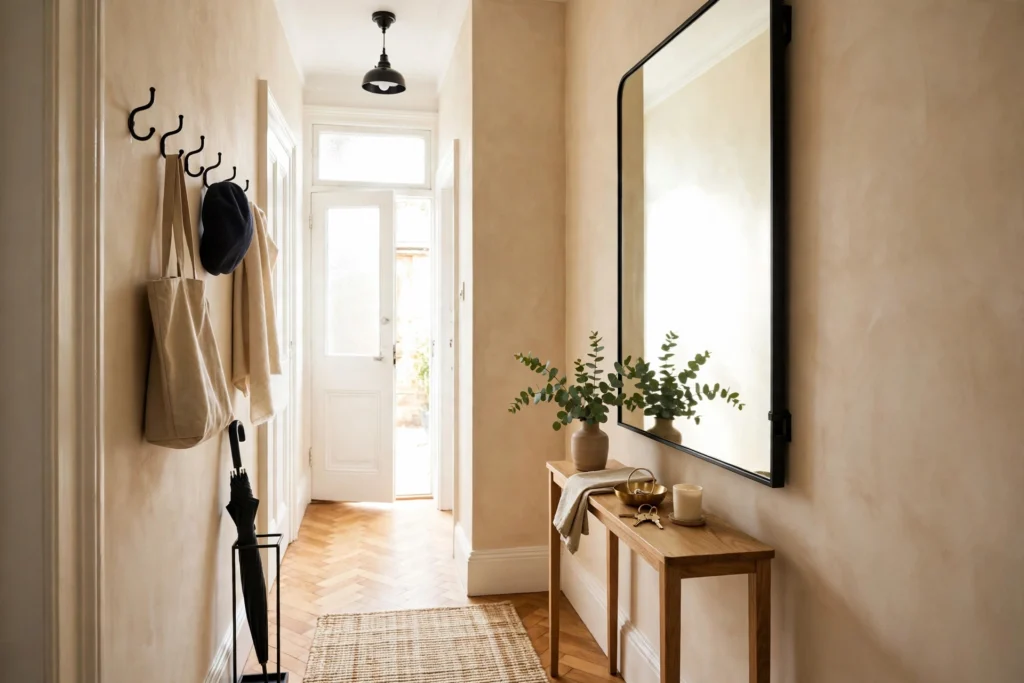
Good hallway ideas are a kind of quiet magic, because the hallway itself fights you: it is usually the narrowest, darkest space in the house, with no windows, too many doors, and a daily avalanche of coats, shoes, bags and post to contain. Yet it is also the first thing you and every guest experience of your home. The difference between an entrance that feels cramped and gloomy and one that feels bright and welcoming is rarely size — it is light, colour, order and a few well-chosen tricks of the eye.
Here are the hallway ideas that genuinely work in small British entrances: colour that opens the space up, mirrors placed with intent, lighting that banishes the cave effect, storage that swallows the clutter, and flooring that leads the eye onwards.
Colour: Light, Warm and Continued
In a small, dark hallway, colour does the heavy lifting. Choose light, warm neutrals — soft whites with a warm undertone, pale warm greys, gentle stone shades — that bounce what light there is and feel welcoming rather than clinical. Two refinements matter. First, paint the woodwork and doors the same colour as the walls (or a shade very close): in a corridor broken up by five door frames, contrast chops the space into pieces, while one continuous colour lets the eye slide along and the hall reads as one long, calm volume. Second, finish matters as much as shade — a soft sheen (eggshell or satin on walls) reflects more light than dead-matt paint and wipes clean where bags and buggies scuff. If you crave stronger colour, use it at the far end wall or on the inside of the front door: depth at the end of the view pulls you in, while dark side walls close the tunnel in.
Mirrors: The Honest Illusion
A mirror is the oldest hallway trick because it works twice: it doubles visual space and throws light back into the room. Place it where it reflects something worth looking at — a window in the door, a light fitting, a picture — not a blank wall or the coat hooks. A large mirror over a slim console table on the longest wall gives you the classic bright-hallway postcard; a cluster of smaller mirrors does the same job in a more relaxed style. In the narrowest halls, a mirror on the end wall can be startlingly effective, visually doubling the length. Practical note: hang it at head height for a final check on the way out, and in a busy family hallway, choose a framed mirror with safety backing and fix it properly — it will be bumped.
Lighting: Banish the Single Bare Bulb
Most hallways suffer from one ceiling pendant in the middle doing its gloomy best. Layer the light instead. A bright, warm ceiling light (or two, in a long hall) for general illumination; wall lights or a picture light to wash the walls and kill shadows in the corners; and, if there is a console table, a small lamp for the warm pool of light that says ‘home’ the moment the door opens. Where a glazed front door or fanlight is an option, borrowed daylight beats every bulb — frosted glass in an internal door to a bright room can transform a hall without touching the structure. Motion-sensor LED strips under a stair or along skirting are a cheap, surprisingly luxurious touch for night-time trips.
Storage: A Home for Everything at the Door
Hallway clutter is not a character flaw; it is a storage shortage. The rule is a designated place for everything that enters, within arm’s reach of the door: a row of sturdy hooks at two heights (adults’ and children’s), a bench or shoe cabinet that hides footwear (slimline tilting shoe cupboards fit halls barely a metre wide), a basket or tray for post and keys on the console, and — if there is an under-stair cupboard — labelled boxes so it stores rather than swallows. Keep the floor completely clear: nothing shrinks a hallway faster than a shoe drift along the skirting. A washable runner protects the floor and adds the colour and pattern that a small, furniture-free space can actually carry.

Flooring: Lead the Eye
Flooring sets the direction of travel. Running boards, tiles or a runner lengthways down the hall stretches it visually; a runner with a border defines a ‘path’ and makes the space feel considered. Keep the hallway floor the same material as the rooms it leads to where possible — continuity of surface is one of the strongest ‘bigger home’ signals there is, and thresholds chop space up just like contrasting paint does. Choose hard-wearing, washable finishes: this is the highest-traffic, wettest-shoe zone in the house, and pale carpet in a hallway is a decision you make once.
The Bottom Line
Make a small hallway feel bigger and brighter with one continuous light colour on walls, doors and woodwork; a mirror placed to catch the light; layered lighting instead of one bare bulb; storage that gives every coat and shoe a home; and flooring that runs lengthways and flows into the rooms beyond. None of it needs a builder — and the welcome it creates is out of all proportion to the space it happens in.
Frequently Asked Questions
What is the best colour for a small dark hallway?
A warm, light neutral — soft warm white, pale stone or light warm grey — in an eggshell or satin finish for walls. Paint doors and woodwork the same colour to avoid chopping the space up, and add stronger colour only at the far end or on the inside of the front door.
Where should a mirror go in a hallway?
On the longest wall, where it reflects light or something attractive — a glazed door, a lamp, artwork. Over a slim console table is the classic arrangement. In very narrow halls, a mirror on the end wall visually doubles the length.
How do I fit storage in a very narrow hallway?
Go slim and vertical: a tilting shoe cabinet (often under 20cm deep), wall hooks at two heights, a narrow bench with storage, and baskets on wall shelves. The golden rule is keeping the floor completely clear.
Should a hallway runner run lengthways?
Yes — lengthways lines and patterns draw the eye along the hall and make it feel longer. A bordered runner adds definition; choose a washable, hard-wearing one, because hallways take the worst of the weather and traffic.


