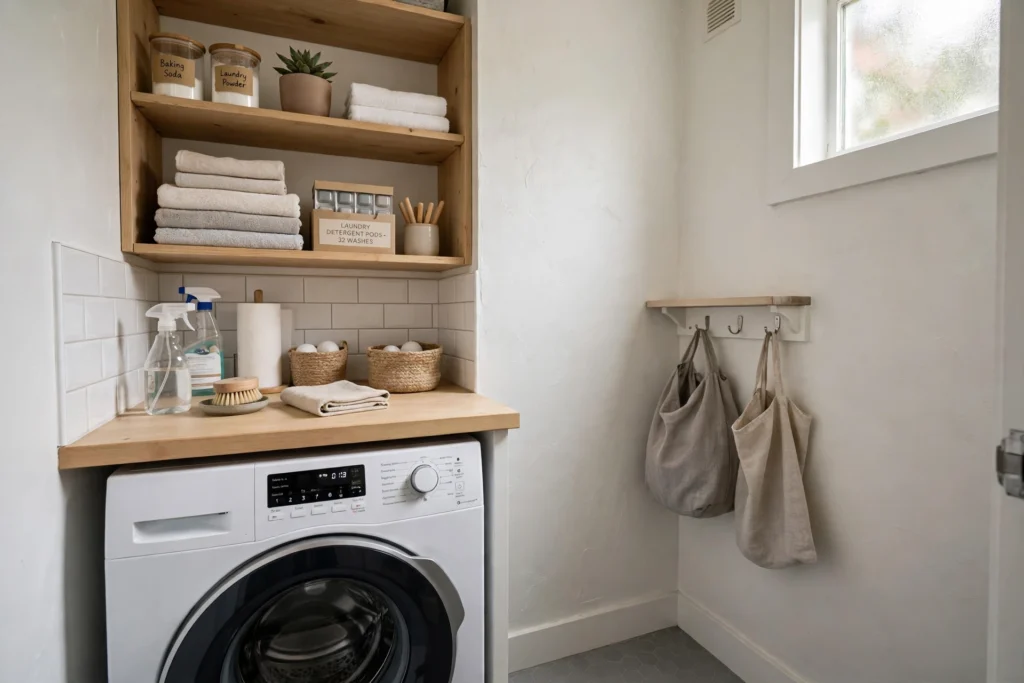
A utility room is the smallest hard-working space in most homes — in many, not a room at all but a cupboard, garage corner or hallway end. Whatever its size, it must hold laundry at every stage — dirty, washing, drying, folded — plus the machines and cleaning kit that serve the whole house. The difference between a space that works and one that becomes a damp pile of baskets is rarely square metres. It is layout: machines placed where the plumbing runs, a worktop where hands need one, storage matched to what is actually stored, and a planned answer to the question every laundry faces — where does wet washing dry?
Layout First: Machines, Plumbing and the Worktop
Start with the fixed points. Machines and sinks need water in, waste out and power, and moving plumbing is the most expensive change in a small room — so plan around the existing pipe runs. Group the wet zone together — machine, sink and dishwasher if there is one — along one wall or in an L. A sink earns its place more than any other extra: muddy boots rinsed, brushes washed, delicates soaked. A deep Belfast-style or stainless sink copes with all of it; a shallow kitchen offcut does not.
Then fight for the worktop. A continuous worktop over side-by-side machines is the single most useful feature in any utility room — a folding and sorting surface, and a home for baskets that is not the floor. Leave at least 60cm if the room allows, and arrange the space in the order work flows: washing in, machine, drying or folding, washing out. Keep a clear floor path through it; a room you cannot turn around in carrying a full basket will not stay tidy.
Stacking Machines, and What Goes Where
Where floor space is tight, stacking a dryer on the washing machine reclaims a whole footprint. Do it properly: use the manufacturer’s stacking kit — a frame locking the two machines together — never just balance the dryer on top. The washing machine always goes at the bottom: it is the heavier machine, especially full of water and mid-spin. Check the combined height against door swings, and leave room to pull both machines forward for servicing. Vented dryers need a short, straight hose run; condenser models free you from the hose but need filters and water drawers emptied, so leave access.
Store by frequency: daily detergents within arm’s reach of the machine, in a closed cupboard or on a high shelf — all laundry chemicals, especially pods, must be out of reach of small children and pets, and pods belong in a lidded container, not an open basket. Bulky, rarely used items go highest or deepest. The organising logic is identical to a kitchen: our guide to kitchen storage ideas sets out the zone-based approach that keeps cupboards under control, and it transfers directly here.
Storage That Survives Real Laundry Life
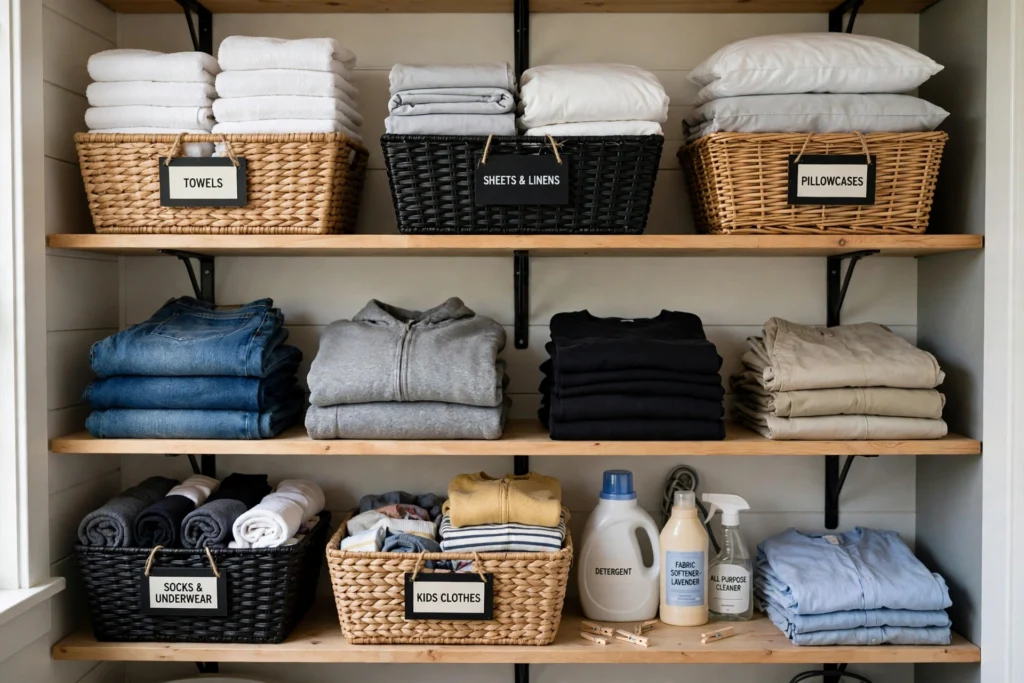
Closed storage beats open shelving for most utility contents, because the room’s stock-in-trade — half-used bottles, dusters, bin bags — is not display material. A tall unit swallows the ironing board, mop and vacuum in one footprint, and does more for the room’s calm than any number of baskets. Where open shelves are used, give everything a labelled box so the shelf reads as a system rather than a spill — labels are what make the system survive other people putting things away.
Build sorting into the room. A two- or three-bag sorter — lights, darks, delicates — means loads assemble themselves, beating the archaeology of one giant basket. Add a hook rail for aprons and the dog towel, a small drawer for the odd-sock limbo every household accumulates, and a wall-mounted folding ironing board if space is tight. Reserve one shelf for clean folded laundry, so finished loads do not camp on the worktop.
Drying Space, Ventilation and Noise
Drying is the problem that defeats small utility rooms, because a full load holds litres of water that has to go somewhere. Outdoors is best when weather allows; indoors, rank the options by space. A ceiling-mounted pulley rack uses warm rising air and keeps washing overhead — still one of the best solutions. A heated airer costs a few pence an hour and folds flat behind a door. Whatever the method, the moisture must leave: an openable window, an extractor on a humidistat, or a dehumidifier in a windowless room, emptied regularly or plumbed into the sink waste. Drying washing in a sealed space is how a utility room grows mould on its ceiling.
Noise and vibration matter too, especially where the space sits under a bedroom. An anti-vibration mat under the machine, the machine levelled on all four feet, and a solid door shut during spins make a real difference. Avoid the loudest spin late at night — scheduling beats any gadget.
Finishes That Cope, and Dual-Purpose Rooms
Choose finishes for a wet, steamy life. Flooring should be waterproof and grippy rather than beautiful: sheet vinyl, lino or matt porcelain tiles shrug off spills, and well-sealed skirting stops mop water sneaking underneath. Walls and woodwork want washable, moisture-tolerant paint — our guide to paint finishes explains which sheens survive scrubbing and steam, and a bathroom-grade eggshell or satin is the usual answer. If the room sits above living space, add a leak alarm or tray under the machine: the cheapest insurance in the house.
Finally, many utility spaces double as a boot room, and that second job should be planned, not improvised. A bench for shoes, hooks at two heights for coats, a boot tray and a washable mat define the zone; dog kit gets its own closed box. Even a cupboard conversion can work hard: compact stacked machines under a shelf, with racks on the door, give a small flat a genuine laundry station. Small is fine; unplanned is what fails.
Frequently Asked Questions
Can I stack any tumble dryer on my washing machine?
Only with the correct stacking kit for the two models, fitted as instructed — and the washing machine always goes underneath. Check compatibility, total height, and that both machines can still be pulled out for servicing. Never rest a dryer directly on the machine without a kit; vibration will walk it off.
What is the best flooring for a small utility room?
Sheet vinyl is the budget winner: waterproof, warm underfoot, cushioned against dropped jars, and fitted in one piece with no grout lines to scrub. Porcelain tile is tougher but colder and harder. Avoid laminate and real wood, which swell at the first machine leak.
How do I dry clothes in a utility room with no window?
Combine a heated airer or pulley rack with active moisture removal: a humidistat-controlled extractor where ducting is possible, or a dehumidifier emptied regularly or plumbed into the sink waste. Without one, the water in every load ends up in the walls as condensation and mould.
Is a sink worth the space in a tiny utility room?
Usually yes — a compact deep sink earns its footprint daily: soaking, rinsing muddy kit, filling buckets. If the choice is genuinely sink or worktop, choose the worktop and use a bucket in the bath; folding space is the one thing no substitute provides.