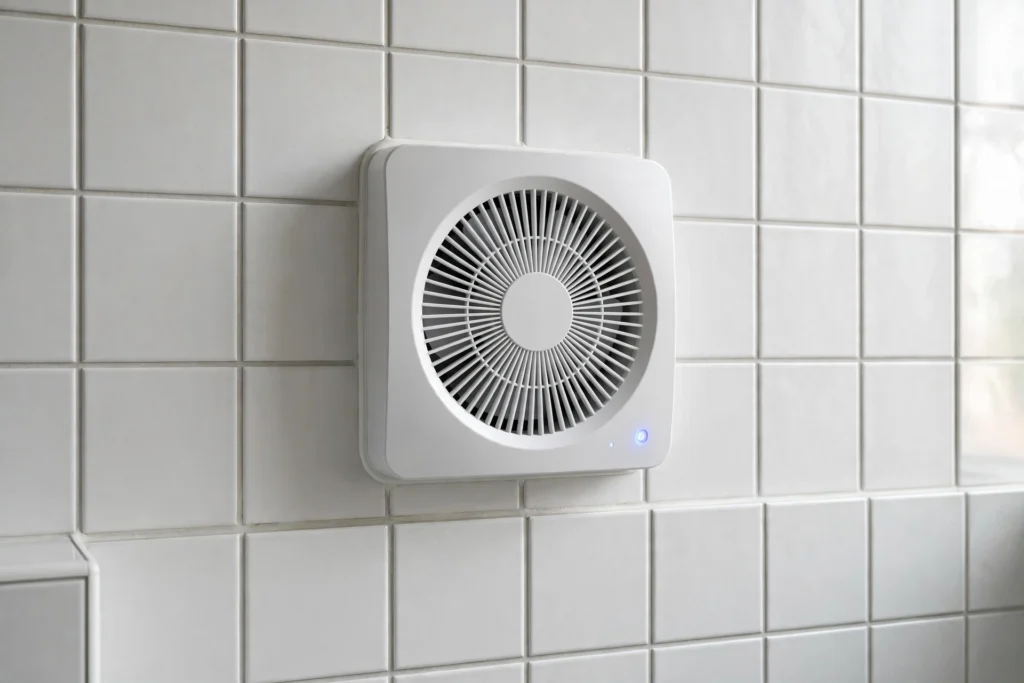
A bathroom extractor fan has one job: remove warm, moisture-laden air before it condenses on cold surfaces and feeds mould. Every shower pumps litres of water vapour into a small room, and an open window in January shifts little of it. A correctly sized fan, vented to outside air and running long enough after each shower, is the closest thing to a permanent fix. Yet fans are often fitted badly: too small, ducted into the loft, or too noisy to use. This guide covers extraction rates, choosing a fan, electrical zones, the legal position on wiring, and ducting that actually reaches outside. Our guide to stopping condensation on windows covers the wider heating and ventilation picture.
How Much Extraction a Bathroom Needs
Building Regulations guidance in England (Approved Document F) sets the benchmark: an intermittent bathroom extractor should extract at least 15 litres per second, while a continuous trickle model should run at about 8 litres per second minimum. Treat 15 l/s as a floor, not a target: a family bathroom with a powerful shower, or any windowless bathroom, does better at 25 to 30 l/s. Fans are sold by duct size — 100mm is standard for bathrooms, 150mm suits larger rooms — and by free-air rate, which falls once ducting and bends are attached. Controls matter as much as power. A timer overrun fan keeps extracting for an adjustable period after the light goes off, and that overrun is what clears post-shower moisture — set at least 15 to 20 minutes. A humidistat fan switches on automatically when humidity passes a set level, suiting bathrooms little lit in daytime.
Choosing the Fan: Type, Position and Noise
The commonest type is the axial fan, a simple propeller design that mounts in a wall or window and works well through a short, straight duct but collapses on long or bendy runs. For longer routes, choose a centrifugal fan, which generates more pressure, or an inline fan hidden in the loft void with ducting either side and just a discreet grille in the bathroom — the noisy motor sits away from the room. Noise genuinely matters: around 25 to 35 dB is unobtrusive, while a cheap 45 dB unit sounds like a small aircraft and gets switched off and forgotten. Position the fan high and as far from the door as practical, so air is drawn across the whole room towards the steam source.
Bathroom Electrical Zones and IP Ratings, Explained Simply
Bathrooms are divided into zones by closeness to water, and the zone decides what electrical equipment is permitted. Zone 0 is inside the bath or shower tray: only very low voltage, specially rated equipment belongs there, never a mains fan. Zone 1 is directly above the bath or shower, up to 2.25 metres from the floor: a fan here must be at least IPX4 rated — splash-proof, or IPX5 where water jets are used for cleaning — and in practice should be a low-voltage model fed through a transformer outside the zones. Zone 2 extends 60cm beyond zone 1, and fans there also need a minimum IPX4 rating. Outside the zones — most ceilings and walls well clear of water — standard equipment is permitted. All bathroom circuits must have 30mA RCD protection. Manufacturers mark each fan’s permitted zones on the box — check before buying.
The Legal Position: Part P and When You Need an Electrician
In England, electrical work in a bathroom is notifiable under Part P of the Building Regulations, because bathrooms are special locations. Adding a fan where none existed, or installing or extending a circuit, must be done either by a registered competent electrician — NICEIC, NAPIT or similar — who self-certifies the work, or be notified to building control in advance and inspected. Scotland and Wales have their own rules — check yours. The generally accepted exception is like-for-like replacement: swapping a failed fan for an equivalent model on the same circuit and in the same hole, without altering the wiring, counts as maintenance. Even then, isolate at the consumer unit and prove the circuit dead first. Fans are often wired through a triple-pole isolator switch outside the bathroom, and timer models need both permanent and switched live feeds. If any of that is unfamiliar, use a registered electrician: the cost is modest and the certificate matters when you sell.
Ducting and Fitting: Getting the Air Outside
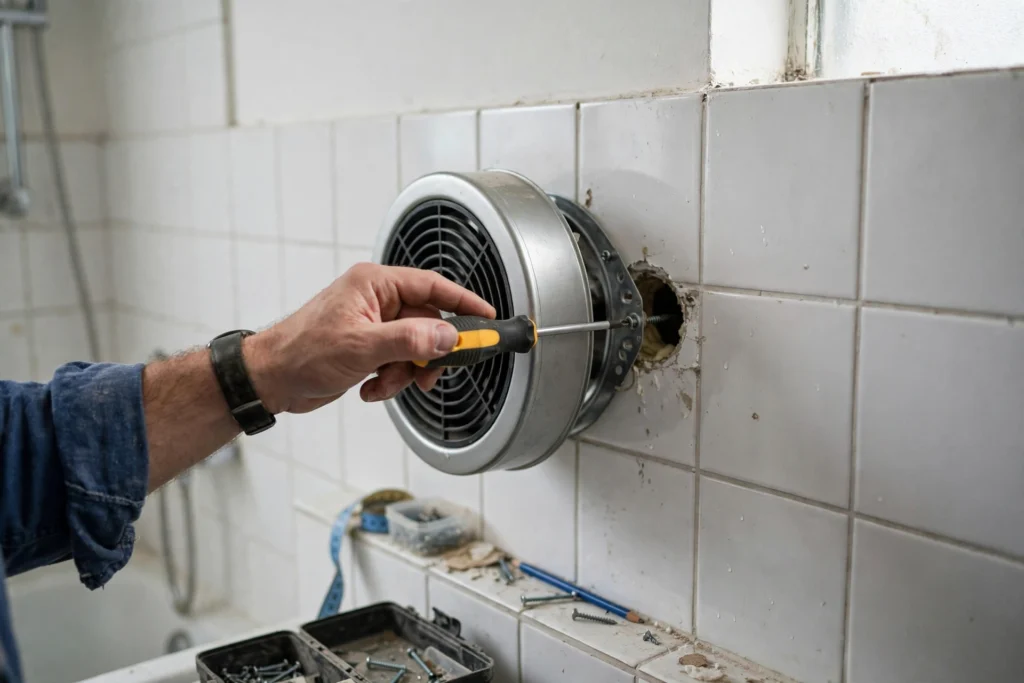
A fan is only as good as its duct. The outlet must discharge outside the building — never into the loft void, a cavity or under a floor, where dumped moisture rots timbers out of sight; loft venting is among the most damaging errors surveyors find. Routes are through the wall itself (simplest for wall fans), or across the loft to a gable grille, soffit vent or roof vent tile. Keep runs short and straight, because every metre and bend cuts the delivered rate, and prefer rigid smooth duct: flexible concertina ducting strangles airflow — use it only for short final connections, pulled taut. Insulate ducting crossing a cold loft, or condensation forms inside it and drips back through the fan, and fit an external grille with a backdraught shutter. Wall holes are cut with a hired core drill (107mm or 152mm) with a slight outward fall so condensation drains out. A like-for-like swap is then straightforward: isolate and prove dead, photograph the wiring, swap the unit, restore power and test the controls. Every few months, vacuum fluff from the grille and impeller — a clogged fan can lose a third of its performance. Moisture also comes from failed fittings, not just steam: our guide to fixing a leaking shower covers the seals and heads worth checking.
Frequently Asked Questions
What size extractor fan do I need for a standard bathroom?
A 100mm fan rated at least 15 litres per second meets the regulations benchmark for most bathrooms. Larger rooms, powerful showers and windowless en suites do better with a 25 to 30 l/s model or a 150mm fan.
Can I replace a bathroom extractor fan myself?
A like-for-like swap using the existing wiring and hole is generally accepted DIY — always isolate at the consumer unit and prove the circuit dead first. A new fan, position or circuit is notifiable work in England and needs a registered electrician or building control approval.
Why does my bathroom still steam up with a fan fitted?
Usually one of four causes: the fan is undersized, the timer overrun is set too short, the duct vents into the loft or runs long and kinked so little air actually moves, or the grille and impeller are clogged. Check in that order before buying a bigger fan.
Where must the duct from a bathroom fan go?
Outside the building, every time — through the wall, a soffit, a gable or a roof vent. Discharging moist air into the structure causes hidden rot and mould that costs far more than proper ducting.