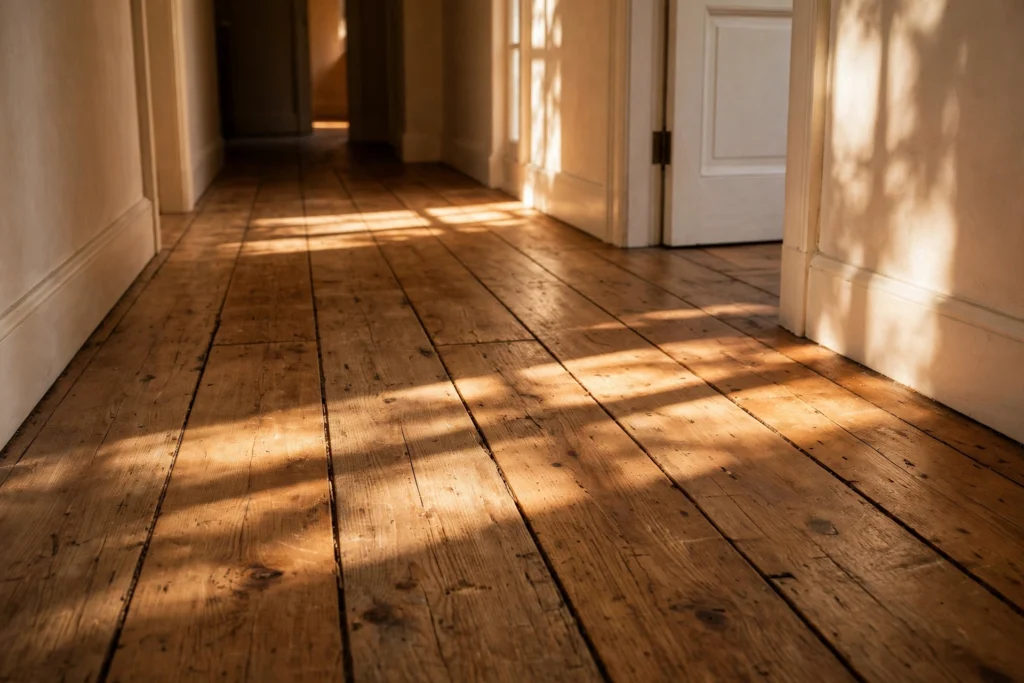
A squeaky floorboard is one of those small household irritations that grows with every nighttime trip to the bathroom. The good news is that most squeaks have a simple cause: a board that has worked slightly loose from its joist and now rubs or moves a fraction of a millimetre each time you step on it. The fix is usually straightforward, and you rarely need to rip up the floor to achieve it. The trick is working in the right order — find the exact board, understand why it moves, and choose the fix that matches the access you have. Done properly, a squeak you have lived with for years can be silenced in an afternoon.
Find the Exact Squeak
Start by walking the floor slowly, shifting your weight from heel to toe, and listening. Squeaks travel along boards and joists, so the board that sounds noisy is not always the one that moves — sound carries, and a board two rows away can be the real culprit. Get someone else to walk while you listen from the room below if you can, or press down on suspect boards one at a time with your foot and feel for movement. Mark the exact spot with a piece of masking tape, and note whether the board moves up and down, rocks side to side, or rubs against its neighbour. Also check the obvious: a loose nail that has worked its way up, a board that has shrunk and left a gap, or a joist that has dried and dropped slightly. Knowing which of these you are dealing with decides the fix, so spend ten minutes on diagnosis before you reach for any tool. If the squeak is under a fitted carpet, you can still find it by walking the carpeted floor and marking the spot — the fix from above works through carpet too, with a little extra care.
Fixes From Above: Screws, Talc and Lubricant
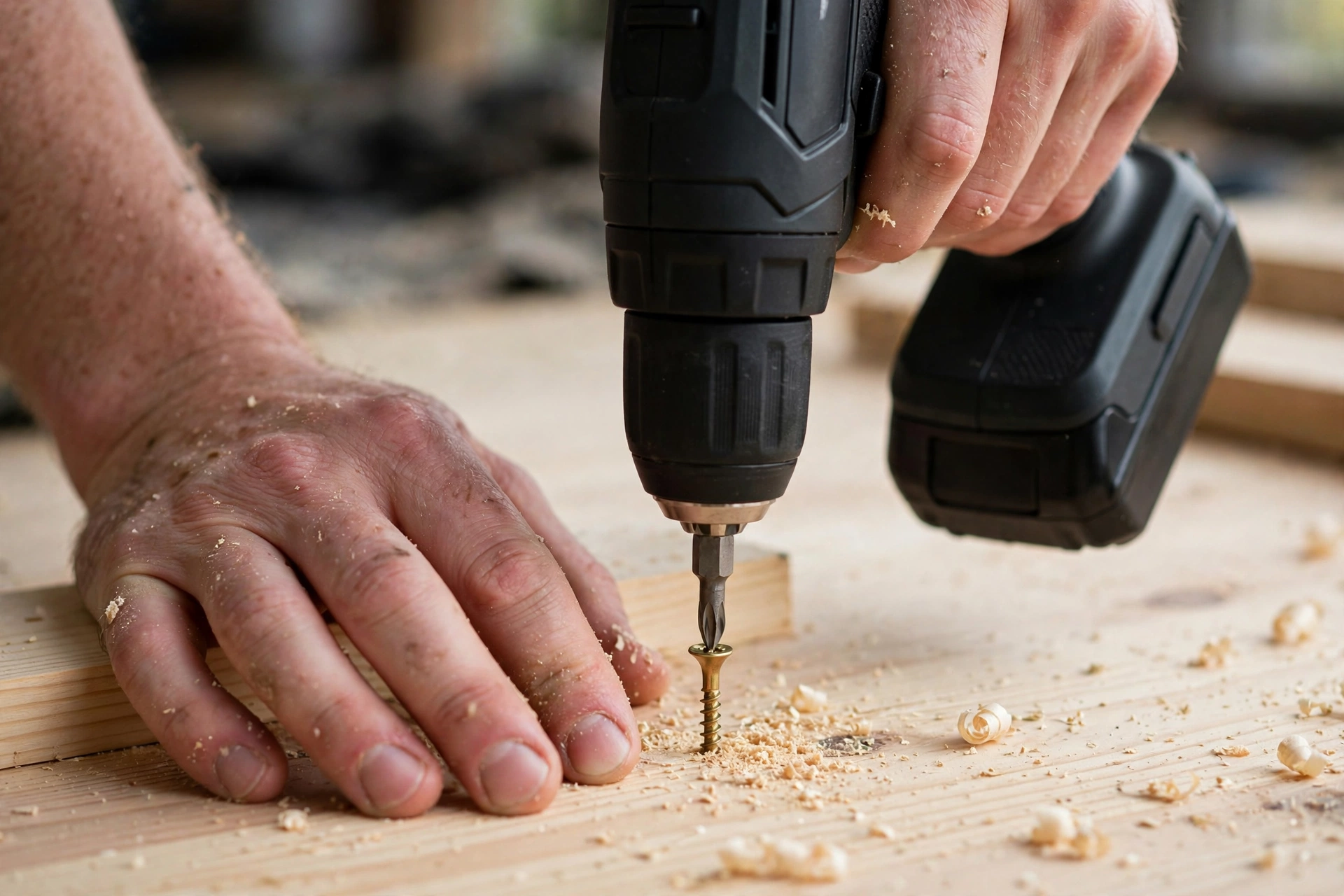
For most squeaks, the best fix from above is to screw the board firmly back down to the joist. Find the joist by locating the existing nail heads — they run in a line across the boards — or use a stud finder. Drill a small pilot hole through the board into the joist to prevent splitting, then drive a wood screw (around 50mm for a standard 20mm board) until the board pulls tight and flush. Screws beat nails here because they grip and hold: nails work loose again as the board flexes, while a screw clamps the board to the joist and stays put. Countersink the head slightly and fill the hole with wood filler if the floor is on show. If the squeak is board rubbing against board rather than board against joist, a dry lubricant can help: work powdered talc, graphite powder or even a little washing-up liquid into the gap between the boards and walk over it to work it in. This is a quick fix rather than a permanent one, but for a minor rub it can last months, and it costs almost nothing. For carpeted floors, a purpose-made squeak repair kit lets you drive a scored screw through the carpet that snaps off below the surface — no visible hole and no need to lift the carpet.
Fixes From Below (Cellar or Underfloor Access)
If you can get underneath the floor — from a cellar, a crawl space, or by lifting a hatch — you have more options, and often better ones. Get someone to walk above while you watch from below: you will see the board flex and hear exactly where it rubs. The classic fix is to pack the gap between the top of the joist and the underside of the board with a thin hardwood shim or wedge, glued in place so it cannot work loose. Do not hammer a wedge in so hard that it lifts the board and creates a bump — snug is enough. Alternatively, screw a short block of wood (a noggin) alongside the joist and up against the underside of the board, or run a bead of flexible wood adhesive along the joist where the board meets it. Adhesive alone is not a structural fix, but combined with a shim or block it stops the micro-movement that causes the noise. Working from below also lets you check the joists themselves: a joist that has cracked, rotted or been weakened by old pipe notches is a different problem, and one you should not simply screw over.
When to Lift a Board and When to Call a Professional
Sometimes the only proper fix is to lift the board. If a board is split, warped, badly cupped or rotten, no amount of screwing will silence it — it needs to come up, and either be refixed properly or replaced with a matching board. Lifting is also the answer when a pipe or cable under the floor is the thing rubbing, or when a previous repair has left a mess of nails and filler. Cut along the board carefully with a circular saw set to the board’s depth (never deeper — pipes and cables hide just below), lever it up gently, and refix it with screws rather than nails. Call a professional if the joists themselves are damaged, if the floor has dropped noticeably, if you suspect rot or woodworm across a wide area, or if the squeak is in a ground floor with no access and a solid or concrete subfloor underneath — that is a different construction and a different job. And if you are planning a bigger floor change anyway, remember that a new surface can hide old problems rather than solve them: read our guide to lay laminate flooring before covering a squeaky floor, because a noisy subfloor will still creak under laminate. For most squeaks, though, a Sunday afternoon with a drill and a box of screws is all it takes — one of the most satisfying DIY home projects you can finish in a single weekend.
Frequently Asked Questions
Why do floorboards start squeaking in the first place?
Usually because wood dries and shrinks over time, nails work loose, or the joist drops slightly. Any of these leaves a tiny gap, and the board moves and rubs each time weight crosses it. Central heating drying out a house in winter often makes squeaks worse, which is why they seem to appear in autumn.
Should I use nails or screws to fix a squeak?
Screws, almost always. Nails rely on friction and work loose again as the board flexes; screws clamp the board tight to the joist and hold. Use a pilot hole to avoid splitting the board, and countersink the head if the floor is visible.
Can I fix a squeak without lifting carpet?
Yes. Find the squeak by walking the carpet, then use a carpeted-floor squeak kit: it drives a scored screw through the carpet into the joist, and the screw snaps off below the surface so nothing shows. It works best where you can locate the joist line accurately.
When is a squeak a sign of something serious?
When the floor feels springy or has dropped, when several boards are affected, or when you can see rot, damp or insect damage underneath. A single squeaky board is normal wear; a whole sagging area needs a professional to check the joists.