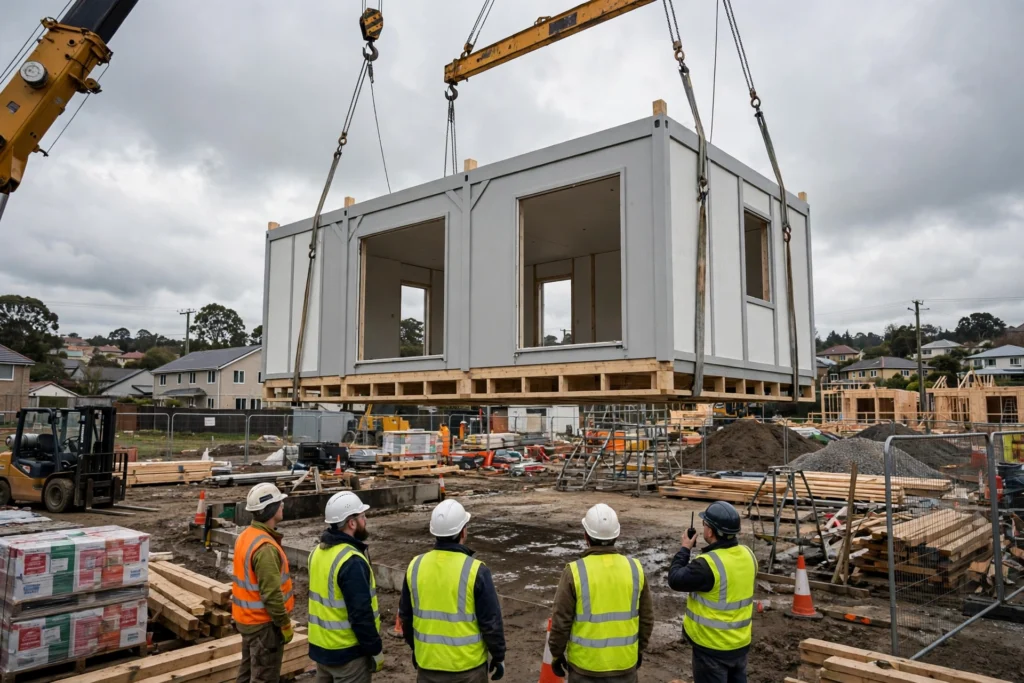
Modular homes are changing how Britain builds. Stand on a new housing development in 2026 and there is a fair chance the house going up in front of you did not start life on that muddy plot at all: its walls, floors and sometimes entire rooms were manufactured in a factory miles away, delivered by lorry, and assembled in days rather than months. Timber frame — for decades the standard in Scotland — has spread across the whole UK, and fully modular construction is following it.
This shift is not a fashion. It is the industry’s answer to three problems that traditional building has failed to solve: too few skilled workers, too much waste and delay, and homes that cost too much to heat. Here is why factory building is winning, and what it means if you are buying, building or just watching a development rise near you.
Timber Frame, Modular, and What the Words Mean
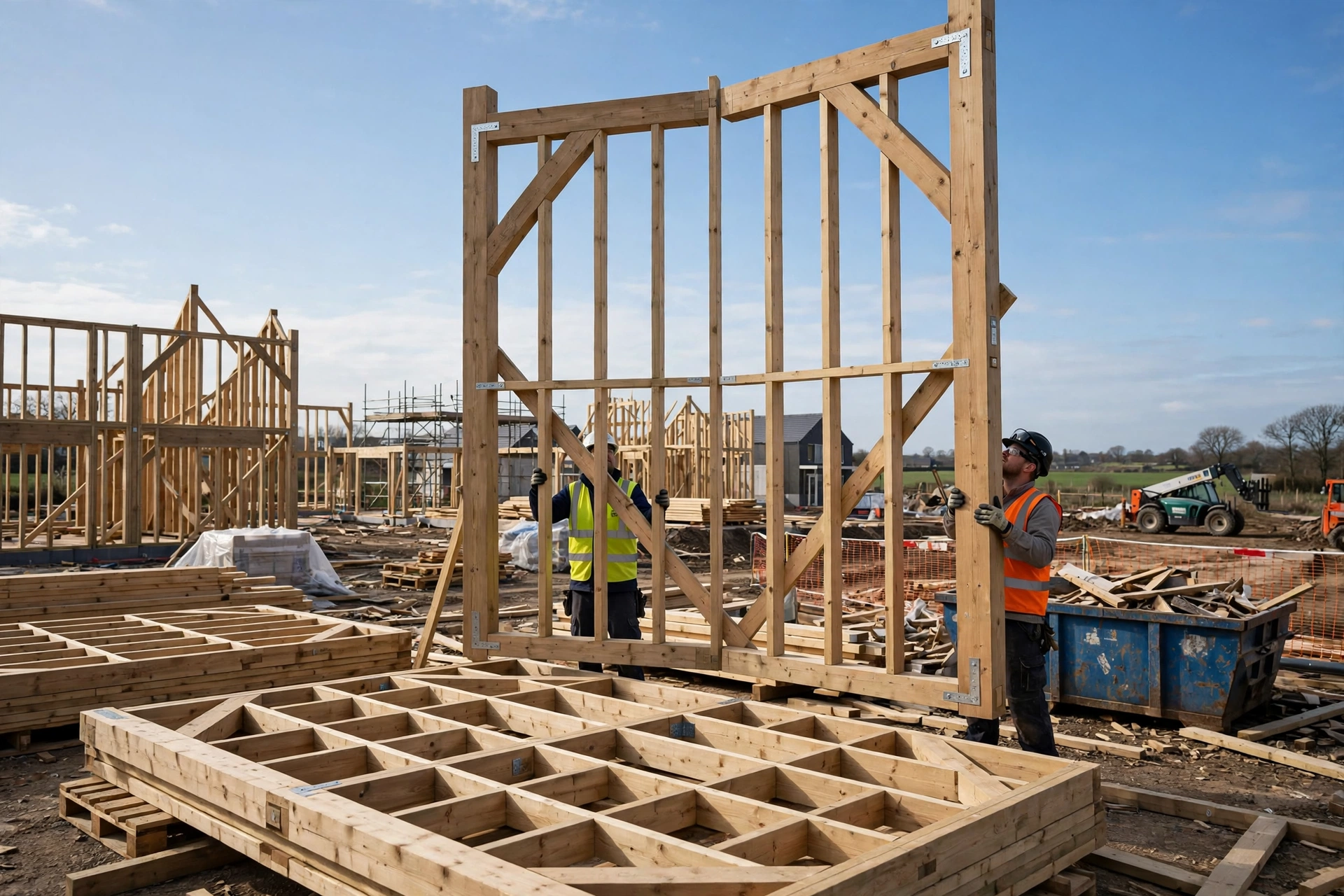
The terms blur together, but they describe a spectrum. Timber frame means the house’s structure is a precision-made wooden frame — panels manufactured in a factory, erected on site in days, then wrapped in brick, render or cladding so the finished home looks entirely conventional. Panelised systems go further, arriving with insulation, windows and sometimes wiring already fitted. Modular (volumetric) construction is the far end: complete three-dimensional rooms — kitchen fitted, bathroom tiled — built and finished in a factory, transported to site and craned into place. The buyer often cannot tell the difference from the street, which is rather the point.
Why Builders Are Making the Switch
Speed. A factory builds in parallel with site groundwork, ignores the weather, and produces a weathertight structure in a fraction of the traditional time. On large sites that speed is money: homes sold months earlier, capital recycled faster.
Skills. Britain does not have enough bricklayers, and training them takes years. Factory construction moves work into controlled environments with repeatable processes, where productivity per worker is far higher and quality does not depend on finding the last good tradesperson in the county.
Quality and energy. Panels built to millimetre tolerances under a roof are simply straighter, drier and better insulated than anything assembled in the rain. Airtightness — the thing that decides whether a new home is genuinely cheap to heat or draughty in disguise — is far easier to guarantee from a production line. Waste falls too, because materials are cut precisely and offcuts are reused rather than skipped.
The Challenges Nobody Should Hide
The factory model has real risks, and Britain has already seen some. Modular factories need constant, high-volume orders to survive; when the housing market dips, the factory’s fixed costs do not — several high-profile modular firms have failed in recent years, leaving the industry more cautious. Transport limits module sizes and adds cost over distance. And the planning and warranty systems were designed around traditional building, so lenders, insurers and councils have had to learn to treat a house that arrived on a lorry as exactly what it is: a house.
What It Means for Buyers
For buyers, the practical questions are narrower than the hype. Is the home covered by a recognised warranty (NHBC or equivalent) — for factory-built homes it should be, and your mortgage lender will insist on it. How energy-efficient is it really — ask for the EPC and the airtightness figures rather than accepting ‘eco’ as an adjective. And is the construction type declared clearly, because future buyers and insurers will ask the same questions you should. Beyond that, a well-built modular or timber-frame home should be judged like any other: location, layout, finish, and how it feels to stand in.
The Bottom Line
Britain is building more timber-frame and modular homes because the old way cannot deliver the number, speed and energy performance the country needs. Factories will not replace building sites entirely — but the share of every new estate that arrives by lorry will keep rising. For buyers, that is mostly good news: warmer, straighter homes, built faster. The homework is the same as it ever was — warranty, energy figures, and a builder who will still exist in ten years.
Frequently Asked Questions
Are modular homes as good as traditionally built homes?
A well-made modular or timber-frame home can match or exceed a traditional build for strength, finish and energy efficiency, because factory conditions allow tighter tolerances. Quality depends on the manufacturer — check the warranty and the builder’s track record.
Can you get a mortgage on a modular or timber-frame home?
Yes, in most cases. Timber frame is a mainstream construction type in the UK, and modular homes with recognised warranties (such as NHBC) and accreditation are accepted by most major lenders.
Are timber-frame homes cheaper to build?
Build costs are broadly comparable, but timber frame is usually faster — and speed saves money on site costs and finance. The bigger saving for owners is often lower heating bills from better insulation and airtightness.
How long do timber-frame homes last?
As long as any other modern home when properly built and maintained — the design life is at least 60 years, and much older timber-framed buildings in Britain have lasted for centuries.