Low water pressure shows up in small daily irritations: a shower that will not rinse shampoo, a bath that takes half an hour to fill, a tap that trickles when the washing machine runs. The causes form a short list, and most can be found with no tools at all. Work in order — pattern first, then the single outlet, then your own pipework, then the street — and you will soon know whether the fix is free, cheap, or a plumber’s job.
Pressure Is Not Quite the Same as Flow
Pressure is the force pushing water through the pipes, measured in bar; most UK homes receive between 1 and 3 bar from the mains. Flow is how much water arrives, in litres per minute, and it depends on pressure plus everything the water passes through. A home can have healthy mains pressure and still deliver a miserable flow because a filter is clogged, a valve is half shut or a pipe has furred up inside — which is why you are hunting for a restriction, not just a weak supply. One test settles it: time the cold kitchen tap filling a one-litre jug. Six seconds or less means ten litres a minute or more, which is healthy. Twelve seconds or more means something really is restricted.
Start With the Pattern: One Outlet or the Whole House?
If only one tap or the shower is weak while everything else runs strongly, the cause is local, and it is usually limescale. Unscrew the aerator — the small mesh disc where water leaves a modern tap — rinse out the grit, and soak it in white vinegar for a few hours if it is crusted. Shower heads clog the same way, especially in hard water areas: soak the head overnight in a bag of half vinegar, half water, scrub the nozzles and run it through. Flexible hoses also kink and collapse internally with age, which no descaling cures; swapping the hose takes ten minutes. A cistern that fills painfully slowly while taps are fine points to its own inlet valve — a separate fault, covered in our guide to how to fix a running toilet. And if water runs away slowly rather than arriving slowly, that is drainage, not pressure; our guide to how to unblock a sink or drain covers that side.
If the whole house is weak, note when it began. A sudden drop often means work in the street: ask neighbours whether theirs has dropped too, and check your water company’s website for planned works or a burst main. A street-wide problem is the company’s to fix, free. A problem that has crept in over months is more likely scale narrowing old pipework, a valve never reopened after earlier work, or a small hidden leak stealing flow.
Work From the Street Inwards: Stopcocks and Valves
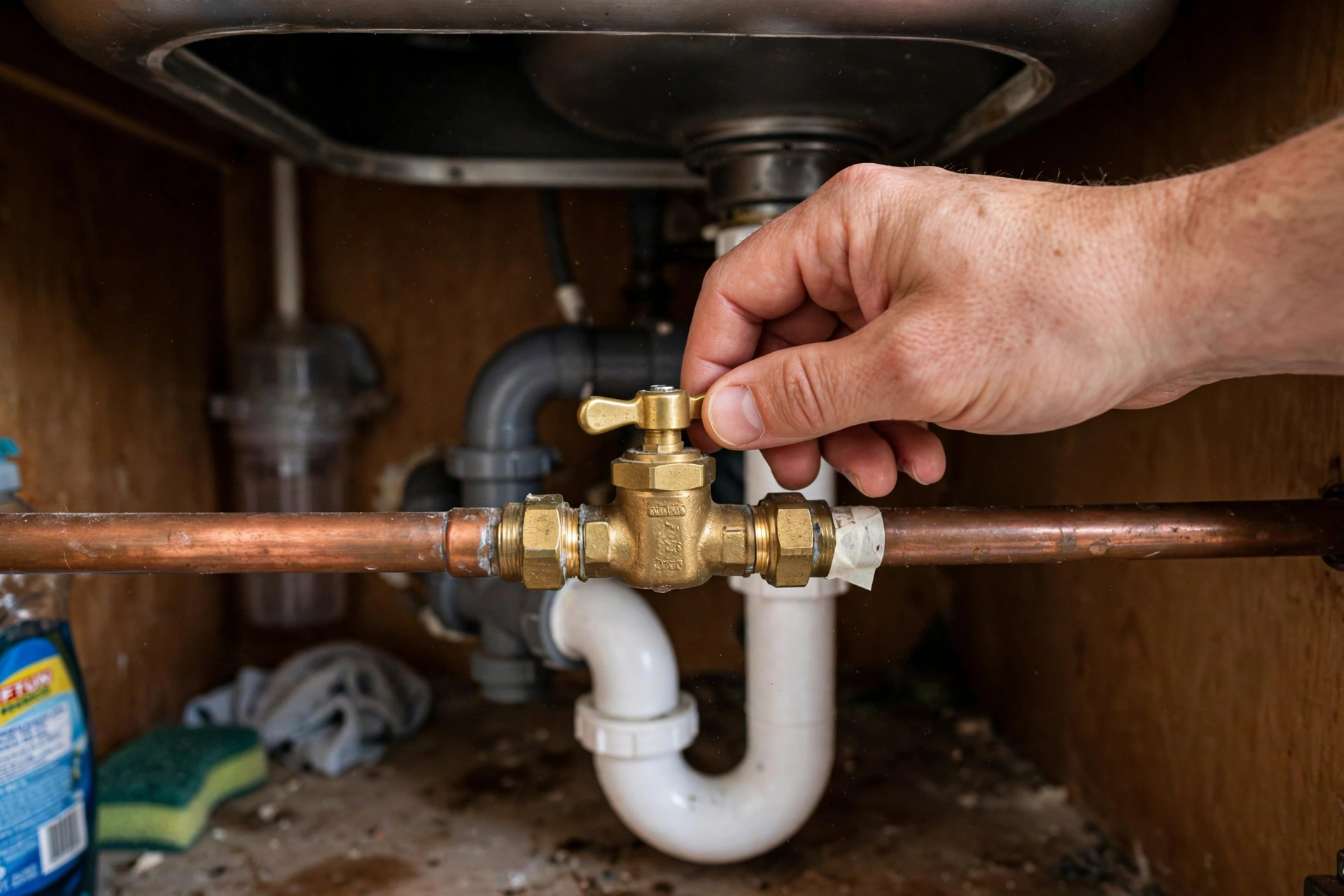
Start at the internal stopcock, usually under the kitchen sink or where the mains enters the house. It is the most common culprit of all: stopcocks get turned down during repairs or a previous leak and are never opened fully again. Turn it fully anticlockwise until it stops, then back a quarter turn so it does not seize there. Next, think of every other valve someone may have touched: isolation valves on taps and toilets, the valve on a water softener or filter, and gate valves on tank-fed pipework. A gate valve can look open while its washer has dropped inside and blocks the pipe — a prime suspect when one group of taps stays weak. The external stop tap, in the chamber at your boundary, belongs to the water company; if it is partly shut or damaged, report it rather than forcing it. The company must maintain a minimum supply to your property, so a fault in the main or their stop tap costs you nothing to repair. Call them before paying a plumber to chase a problem that starts on their side of the boundary.
Boilers, Old Pipes and Hidden Leaks
Some flow problems are design limits. A combi boiler heats water on demand, so opening a second outlet splits what it can supply: a shower that fades when a tap runs downstairs is often a combi working exactly as designed, and the answer is staggering use, not a repair. Homes with a loft tank have the opposite issue — pressure upstairs depends on how far below the tank the outlet sits, so a shower near tank level always feels gentle without a pump. Old pipework in hard water areas slowly narrows with scale; a plumber can confirm by comparing flow at the first tap after the stopcock with the furthest one.
Rule out a hidden leak, too, because it wastes water and steals flow. Turn everything off, then watch your water meter for fifteen minutes: if the dial still moves, water is escaping somewhere. Damp patches that never dry, hissing in quiet pipework, or a meter that creeps overnight point the same way, and a leak on your side of the meter is your responsibility. If you need more than the mains can give, a booster pump is possible — but you cannot pump unlimited water straight off the mains, because that drags on your neighbours’ supply. Small pumps are limited in what they may draw directly; anything hungrier needs a break tank that fills from the mains and is pumped from there — a proper installation job.
Frequently Asked Questions
What is a normal water pressure for a UK home?
Most homes receive roughly 1 to 3 bar at the mains. Your water company must maintain a minimum supply sufficient for ordinary use in a typical two-storey home, so a supply that cannot run a shower properly is worth reporting.
Why is my shower weak but the taps are fine?
That pattern points to the shower itself: a scaled-up head, a collapsed hose, a clogged filter in the shower valve — or, with a combi boiler, another outlet drawing hot water at the same time.
Can limescale really reduce pressure throughout the house?
Yes, in hard water areas. Scale clogs aerators, filters and valves and slowly narrows old pipework. Single outlets respond well to descaling; narrowed pipes themselves need a plumber’s assessment.
When should I call the water company instead of a plumber?
Call the company first if the drop is sudden, affects the whole house, or your neighbours have it too — the fault is likely in the street and free to fix. Call a plumber when the problem is clearly inside your pipework.