Multigenerational living is no longer something families fall into when times get hard. Increasingly, it is something they choose — planned, budgeted and even celebrated. Grandparents move in with their children. Grown-up children stay, or return, and contribute. Three generations share one larger home instead of struggling separately in three smaller ones.
The numbers behind the trend are easy to understand: high house prices, expensive rents, costly childcare and an ageing population all push in the same direction. But money is only half the story. Many families say that once they tried living together, the company, help and security it brought mattered as much as the savings. This article looks at why the trend keeps growing, what it costs, and how families make shared living work in practice.
Why More Families Are Choosing One Roof
Housing costs that punish living separately
Three households means three rents or mortgages, three sets of bills and three lots of council tax. For a young adult saving for a deposit, staying in the family home can be the difference between saving steadily and saving nothing. For grandparents on a pension, merging households can remove the biggest cost of all from their budget.
Childcare and eldercare in one move
Working parents face childcare costs that rival a second mortgage. Grandparents nearby — or in the next room — change that equation overnight. The help flows both ways: as grandparents age, having family in the house means support, company and safety checks are built into daily life rather than arranged at a price.
Homes are being built and bought differently
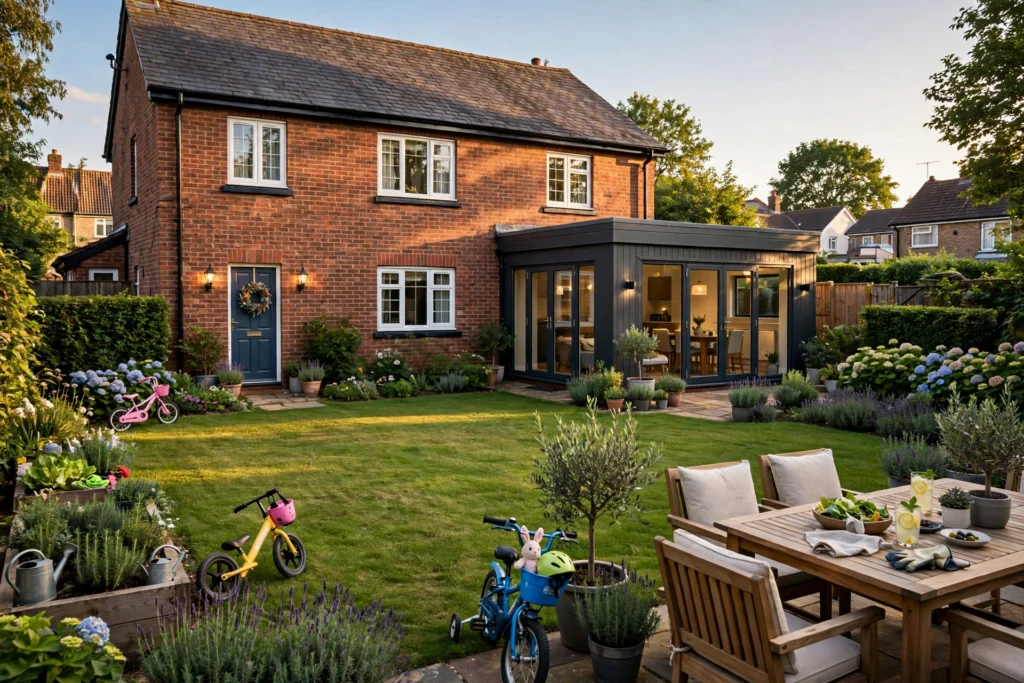
Builders have noticed. New developments increasingly include annexes, dual-entrance layouts and flexible rooms marketed for extended family. Estate agents report that homes with a self-contained granny annexe, a converted garage or a garden room attract a premium from exactly these buyers — the extra space is not a luxury, it is the point.

How Families Make It Work
The families who thrive with three generations under one roof tend to agree on the same handful of rules:
- Private space is non-negotiable. Everyone needs a door they can close — ideally a sitting area and bathroom that are not shared by the whole house.
- Money is discussed early and in writing. Who pays what towards the mortgage, bills and food is agreed before moving in, not argued about after.
- House rules are shared, not imposed. Noise, guests, cleaning and kitchen use are agreed by all adults — including whose home it legally is.
- Legal advice matters. If several people contribute to a purchase, a solicitor should record who owns what share, so everyone’s position is protected if circumstances change.
The Challenges Nobody Should Ignore
Honesty helps: multigenerational living is not automatically harmonious. Privacy shrinks, habits clash, and a home that felt generous with four people can feel crowded with seven. Parking, storage and bathroom queues become real planning issues. Families do best when they trial the arrangement — a long stay before a permanent move — and when they choose a home with more space than they think they need.
There can also be financial tripwires. A relative contributing to a deposit may affect a first-time buyer’s status; an adult child living at home can affect some benefits and tax positions; and ownership shares need care. None of these is a reason not to do it — all of them are reasons to take proper advice first.
What It Means for the Housing Market
As more families combine, demand shifts: fewer small starter homes needed by the young adults who stay put, and stronger demand for larger homes with flexible layouts, annexes and downstairs bathrooms. Sellers of bigger family homes increasingly market that flexibility openly. It is one of the clearest examples of family economics quietly redrawing what a ‘normal’ household looks like.
The Bottom Line
Multigenerational living is growing because it answers several problems at once — housing costs, childcare, eldercare and loneliness — with one decision. It works best in a home with genuine private space, clear money agreements and honest expectations. For a rising number of families, it is not a compromise at all. It is the plan.
Frequently Asked Questions
What is multigenerational living?
It means three or more generations of one family — typically grandparents, parents and children — living in the same home, whether in one household or in a main house with a self-contained annexe.
Does multigenerational living save money?
Usually, yes. Sharing one mortgage or rent, one set of utility bills and one council tax bill is significantly cheaper than running two or three separate homes, and family childcare can save thousands more each year.
What should families agree before moving in together?
How costs are split, how much private space each household gets, house rules for shared areas, and — if buying together — each person’s ownership share, recorded legally with a solicitor.
What type of home works best for three generations?
A home with a self-contained annexe or convertible space, a downstairs bathroom, and enough living areas that each generation can be together or apart as they choose.